13 October 2026 · Behind the scenes
Then Only the Wind Moves
"Ad Astra: Voyage and Return". Seven scenes, and the physics that moves them.
"Ad Astra: Voyage and Return". Seven scenes, and the physics that moves them.
A butterfly is born from petals and snow. It leaves a painted sky, crosses space, a storm and a black hole, is born again from a flash and comes back to settle on an almond blossom. This is the video of Ad Astra: seven scenes, the voyage and the return.
Every frame is computed from physical models, simulated with scientific software and purpose-built code, under my direction. No image was generated by AI. This is why the resolution is arbitrary, limited only by computing power: the published version is true 8K, computed pixel by pixel. The Latin text and the music are mine; the voice of Alma Hale, the choir and the orchestra are AI-rendered.
For a theoretical physicist it is like stepping into a dream. I gave myself one rule: physics must bring the ideas to light, not turn into a display of knowledge. It made me think of a modern, physical version of Fantasia, the Walt Disney film.
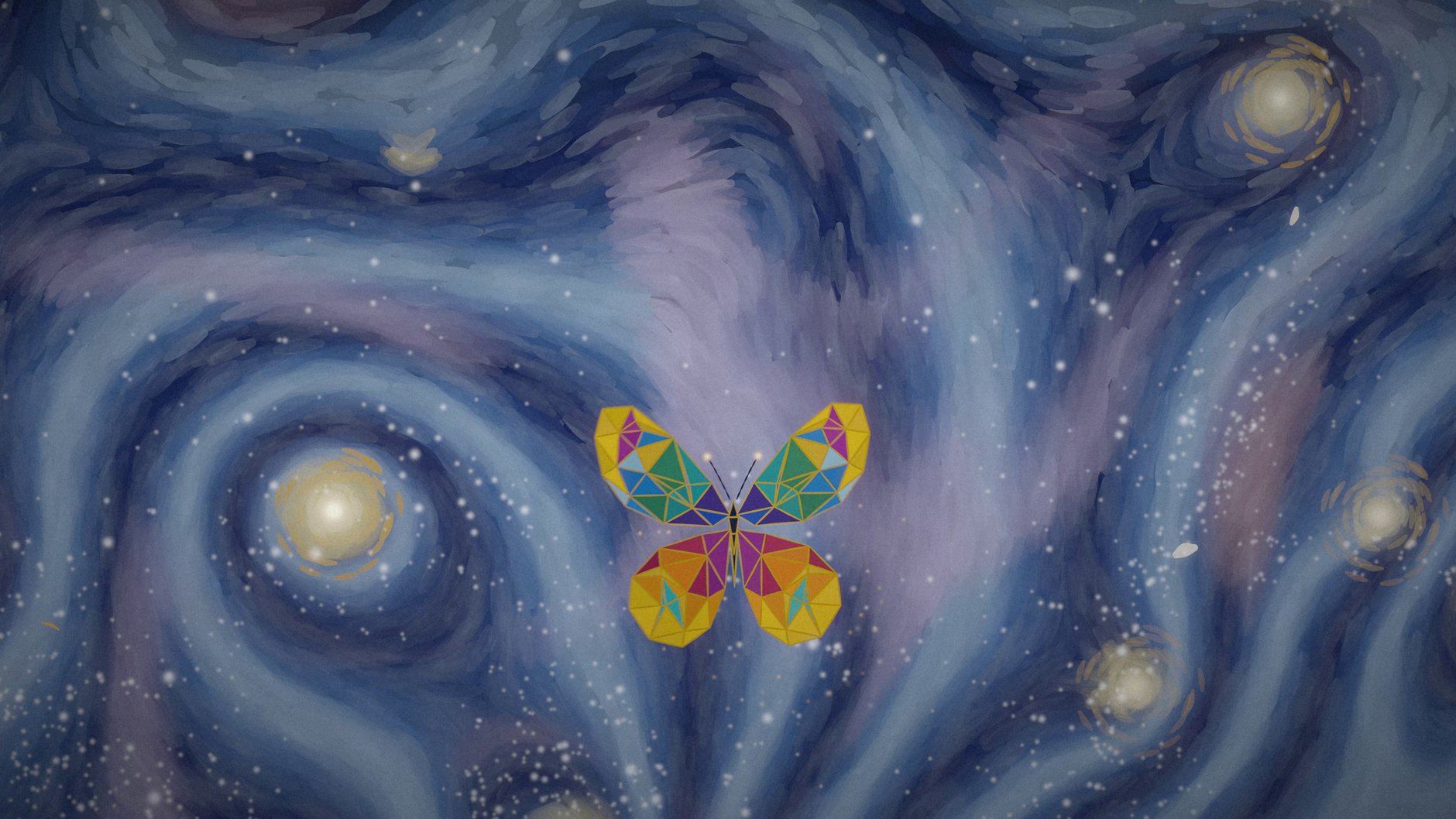
Before the images comes the music. The piece was measured against the score: every chord with its instant, the bass line, the sung phrases, the waves of loudness. The scenes begin where the music breathes, and within each scene the gestures fall on the notes.
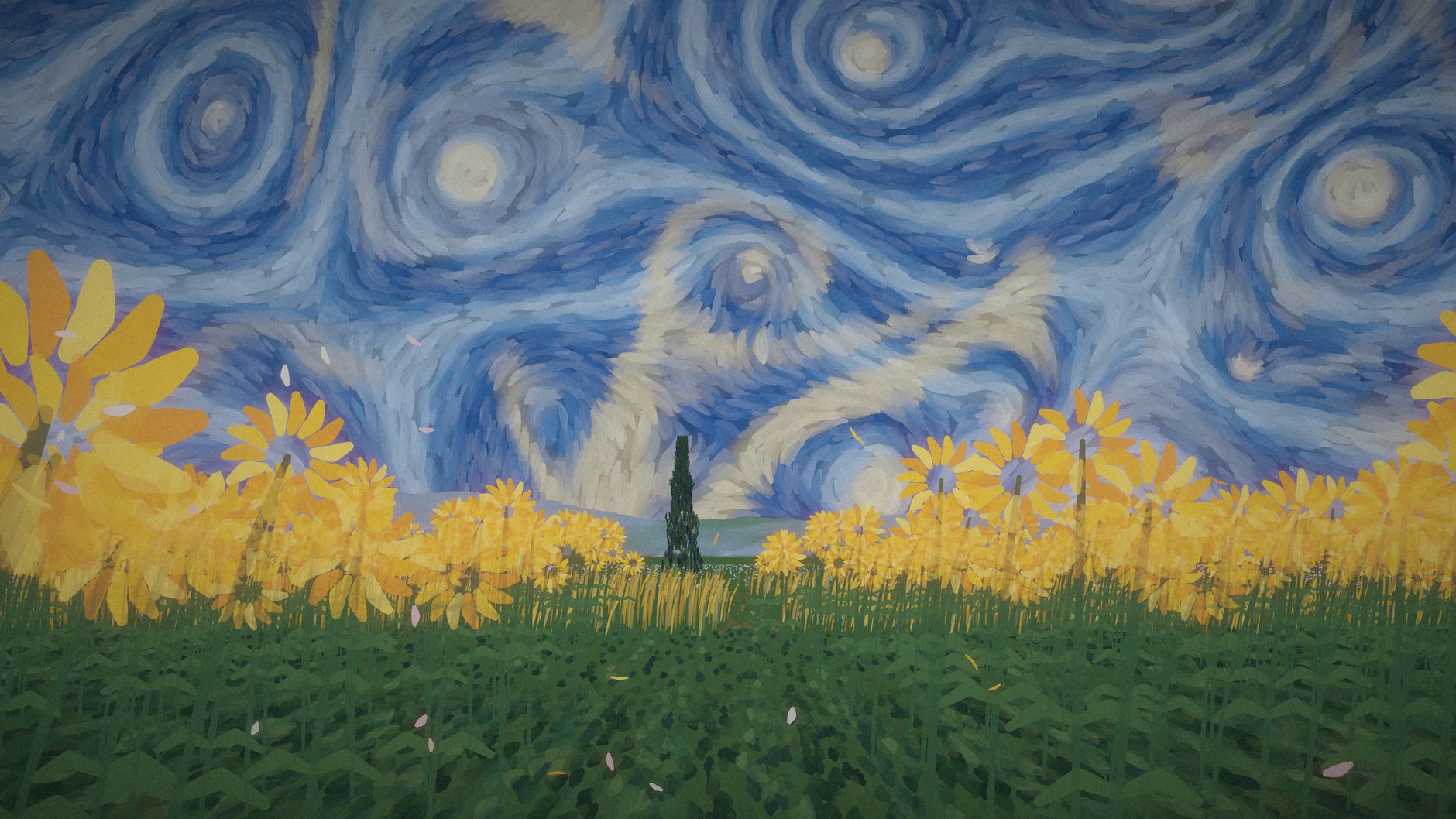
We set out from an almond tree in bloom and walk through one landscape that changes season: the sunflowers, a wheat field with crows, the snow, a starry night with its cypress. They are paintings by Vincent van Gogh, freely reinterpreted.
The sky is a fluid: turbulence in two dimensions, left to evolve until the small vortices merge into large ones. The stars sit at the heart of the vortices. The same wind carries the petals and the snow.
The crows are the dark thoughts leaving. The butterfly is the opposite. It is born at the centre of mass of the petals, which fall toward that point while circling it: like a planet forming out of shapeless matter, by gravitational accretion.
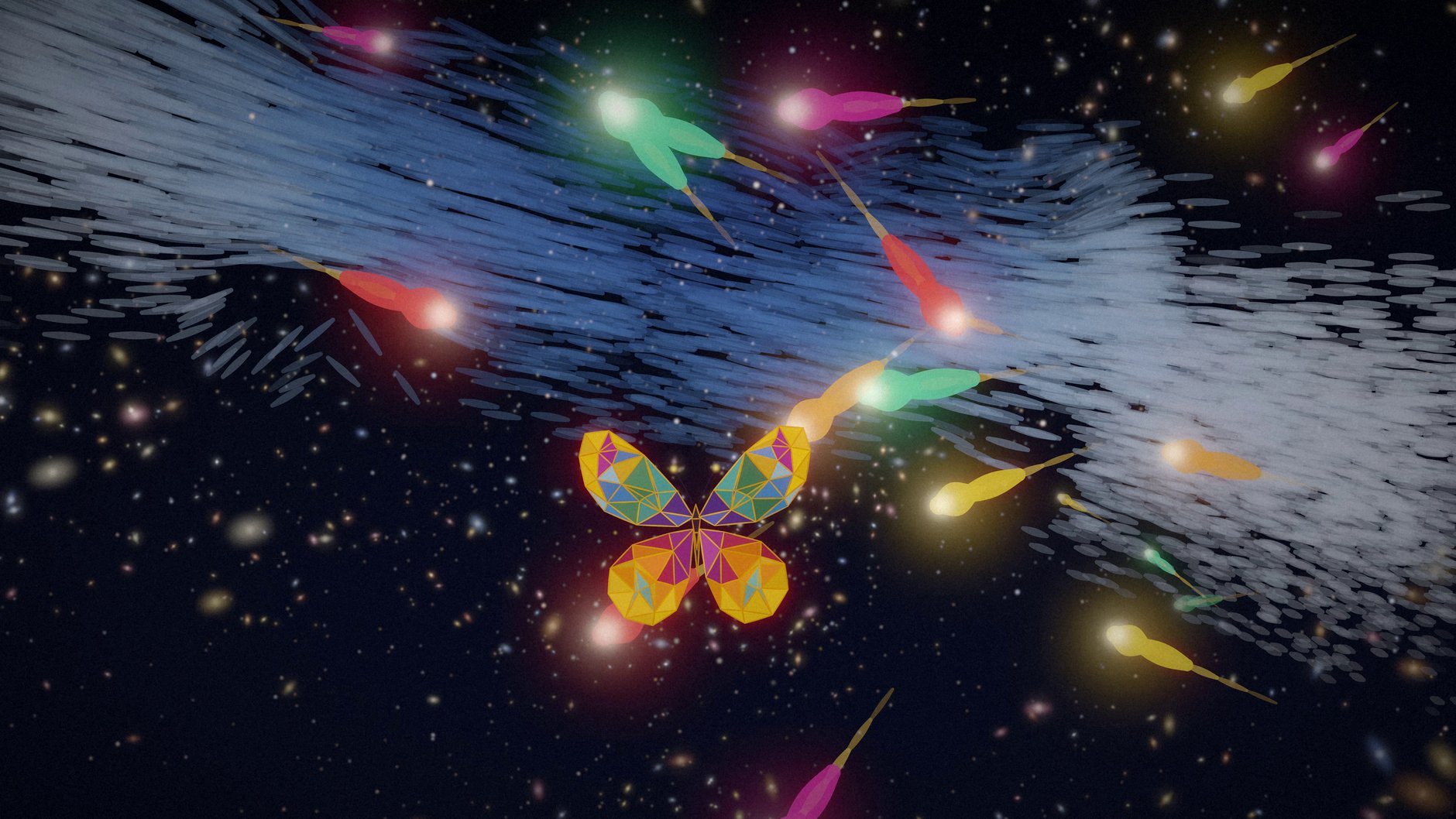
The butterfly leaves the painted sky and heads out into space, faster and faster. Here the physics is special relativity. Whoever travels at a substantial fraction of the speed of light sees the stars gather ahead, and sees them grow brighter and bluer: aberration and the Doppler effect. In the video we reach 72 per cent of the speed of light, on the highest note of the voice.
All but one of the meteors' colours are those of real meteors, one for each element: sodium, magnesium, calcium, iron, the nitrogen and oxygen of the air. And the drift of the flight follows a Lorenz attractor: the curve of chaos, which has the shape of a butterfly.
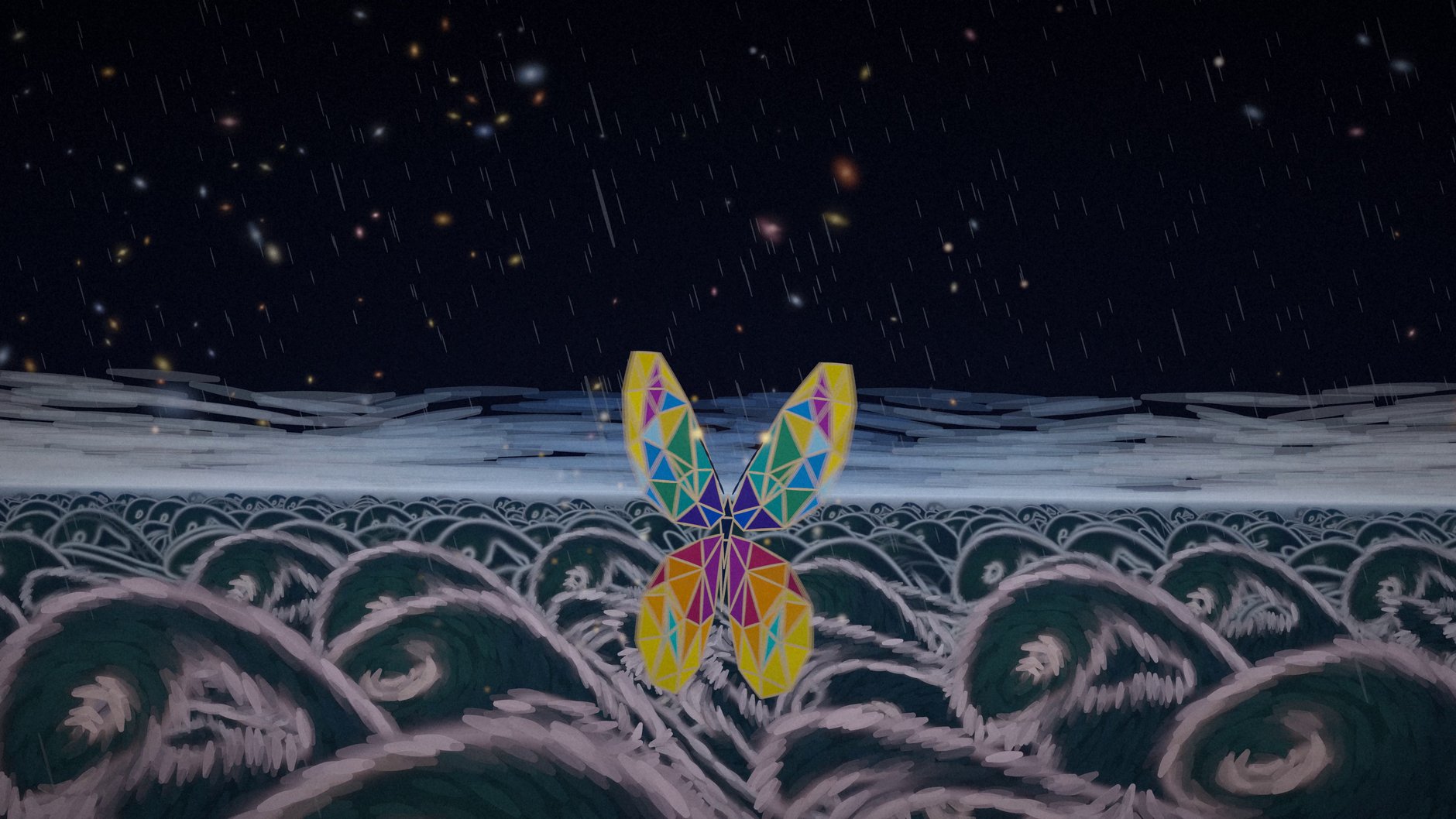
A stormy sea at night. The curling waves are a Kelvin-Helmholtz instability: it arises when two layers of fluid slide past each other at different speeds, and it is the same one that curls certain clouds.
The bass descends by semitones, and the sea descends with it: one row of waves and one step for each chord. A chromatic scale, if you look at it closely, is a helix.
The two bolts of lightning fall on the two D flats. Each is a true discharge: it grows step by step where the electric field is strongest, and that is why it branches.
A confession. The sea is not simulated in three dimensions: each row of waves is a section of the same fluid, at a different distance. Theatre flats, as in the multiplane camera of Fantasia.
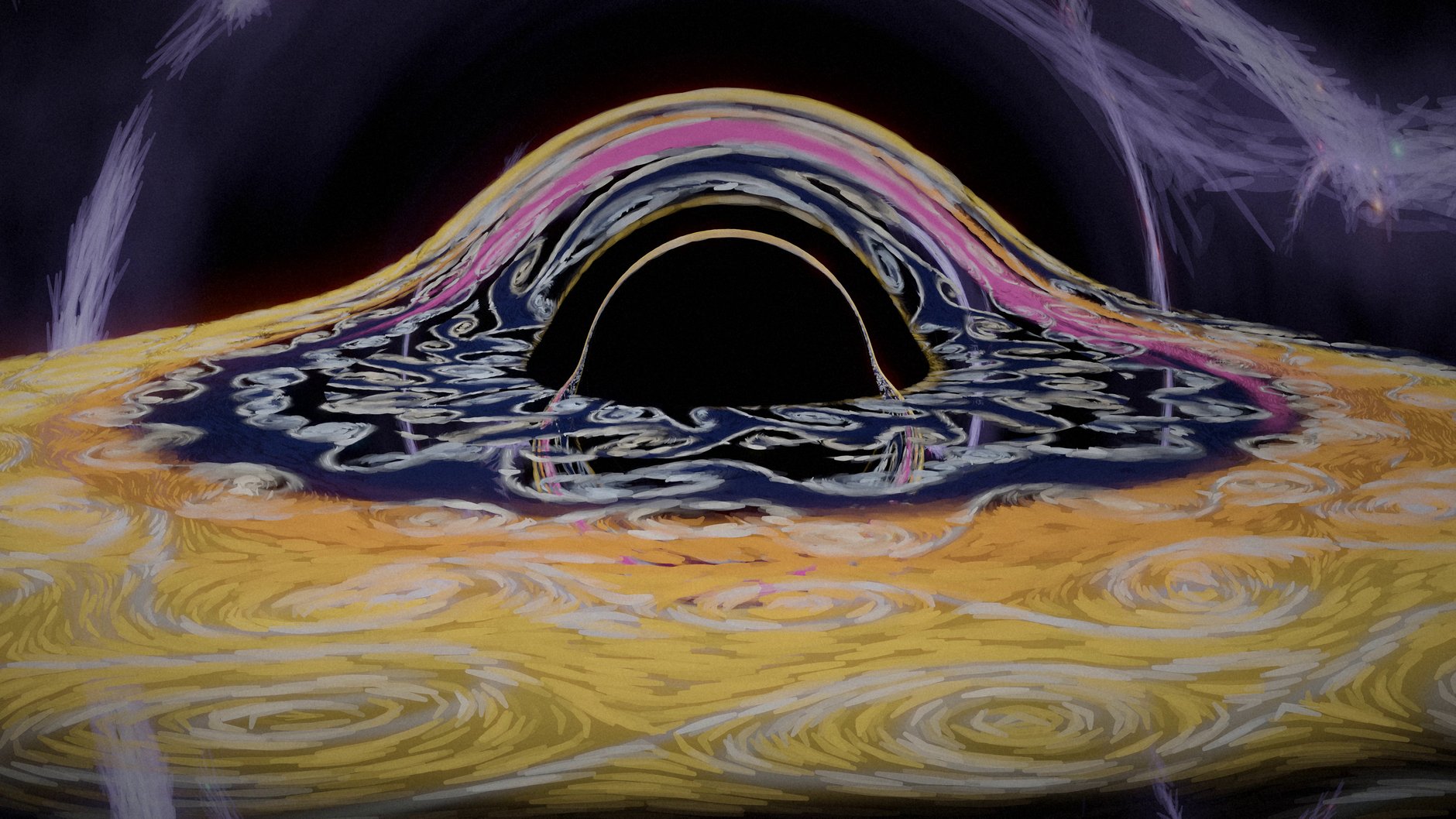
At the end of the cosmic web there is a black hole. I wanted it to be clear how gravity bends space-time, and why the image made famous by Interstellar has exactly that shape.
Here the light is computed exactly, for a black hole that does not rotate: each ray is followed along its path around the mass. The shadow, the photon ring, and the far side of the disc lifted above the shadow all come out by themselves.
When the butterfly passes behind it, gravity bends its image: first two arcs, then, when it is aligned, a full ring. It is an Einstein ring.
The web is dark matter: particles falling under their own gravity in an expanding universe, until they form voids, filaments and nodes. Dark matter is the wire; the galaxies are light bulbs hung on the wires.
The disc, instead, is dreamt. It is the fluid of the storm rolled up into three rings, each turning with the period of its orbit, faster toward the centre, as Kepler's law requires. In place of the disc from the film, the vortex of The Starry Night.
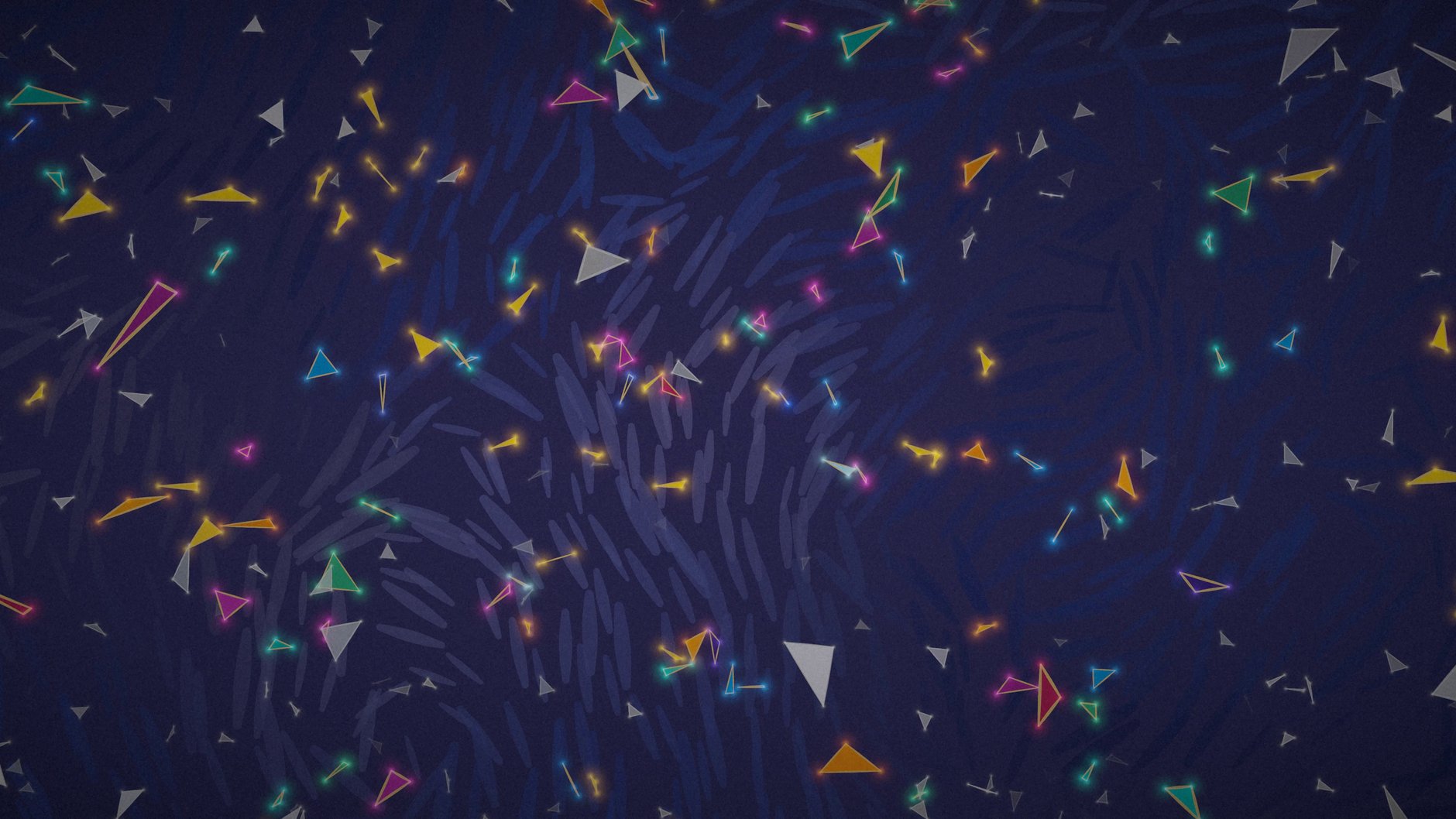
Some think that our own universe may be the inside of a black hole. The scene begins there: dark, then a flash, and a burst of sparks standing still in time. Seen from outside, at the horizon time stands still. It starts again when the voice sings tempus.
How do you put a butterfly back together from the particles of a big bang? String theory was not needed: the story had to hold. The butterfly is made of 117 triangles, and a baryon, like the proton, is made of three quarks. So the model is a cooling plasma. Above a critical temperature the charges are free, in a fluid crossed by sound waves; below it, they bind three by three. Three points of light, a triangle: that is how matter is built.
The light of the sparks cools like that of an incandescent body, from thirty thousand to two thousand five hundred kelvin, one step per chord: from blue-white to gold.
It is a toy, but each of its regimes is true physics. With one licence: real particles of this kind are "white", colour-neutral. Its own are not.
Te quaero sine nomine, says the text. Before the symmetry breaks, the particles are all alike: without a name.
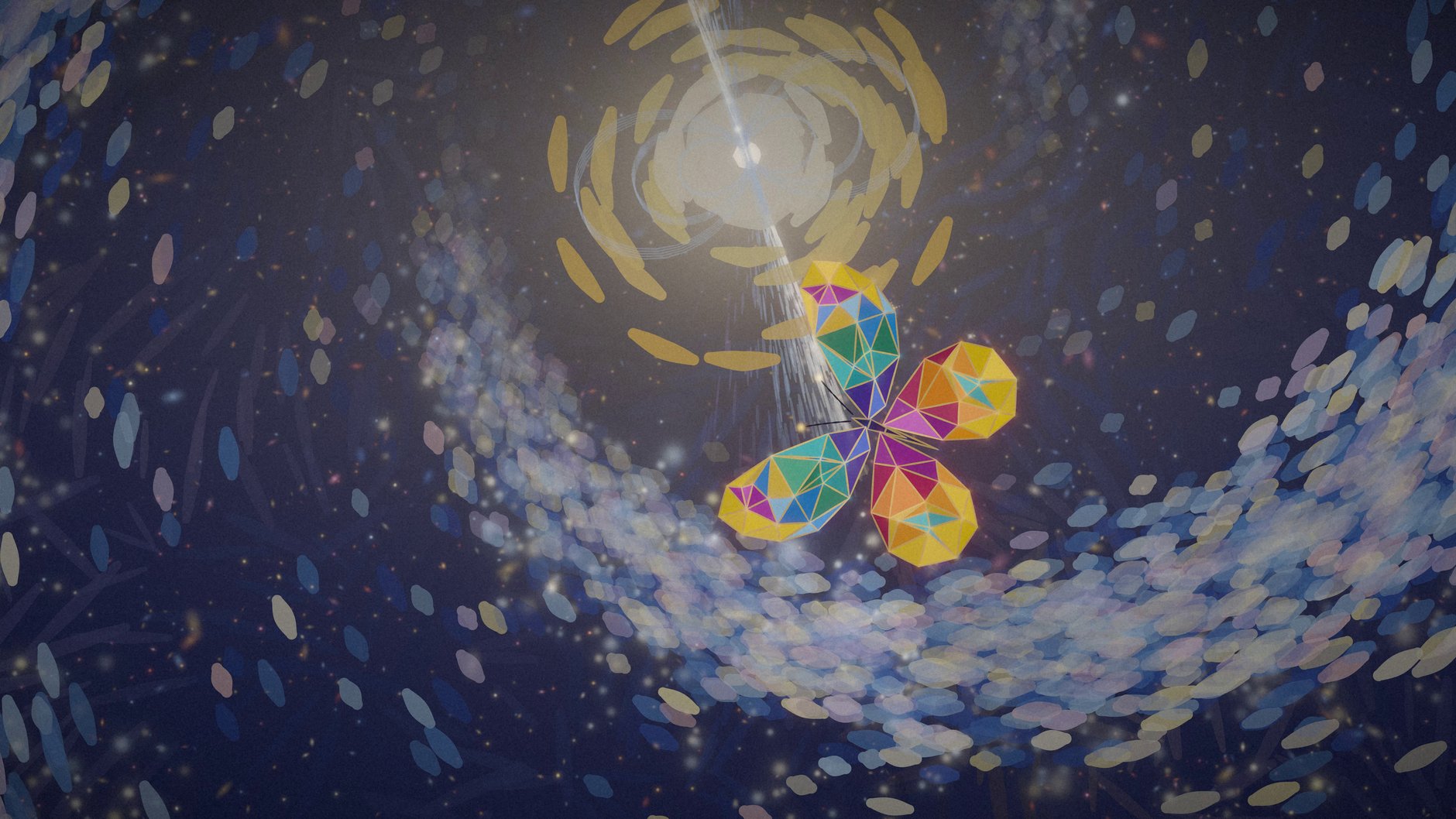
A deep field: countless galaxies. In a real photograph of that kind almost no light is a star. Non omnis lux est sidus: not every light is a star, literally. And among all those lights, for the butterfly, only one is a star.
Non omnis vox est sonus, the verse goes on. That is why its star is a pulsar: a lighthouse that turns and flashes with the regularity of a metronome. The first one, discovered by Jocelyn Bell in 1967, beats every 1.34 seconds. Ours every 1.05: one flash for each beat of the wings.
The butterfly reaches it along the arm of a spiral, while the bass descends twelve notes in a row: one step of the spiral per note, because the chromatic scale is a logarithmic spiral. The light of the star follows the voice.
Then the vortex of the galaxy fades into the painted sky of the beginning, and the star is one of the stars of the painting.
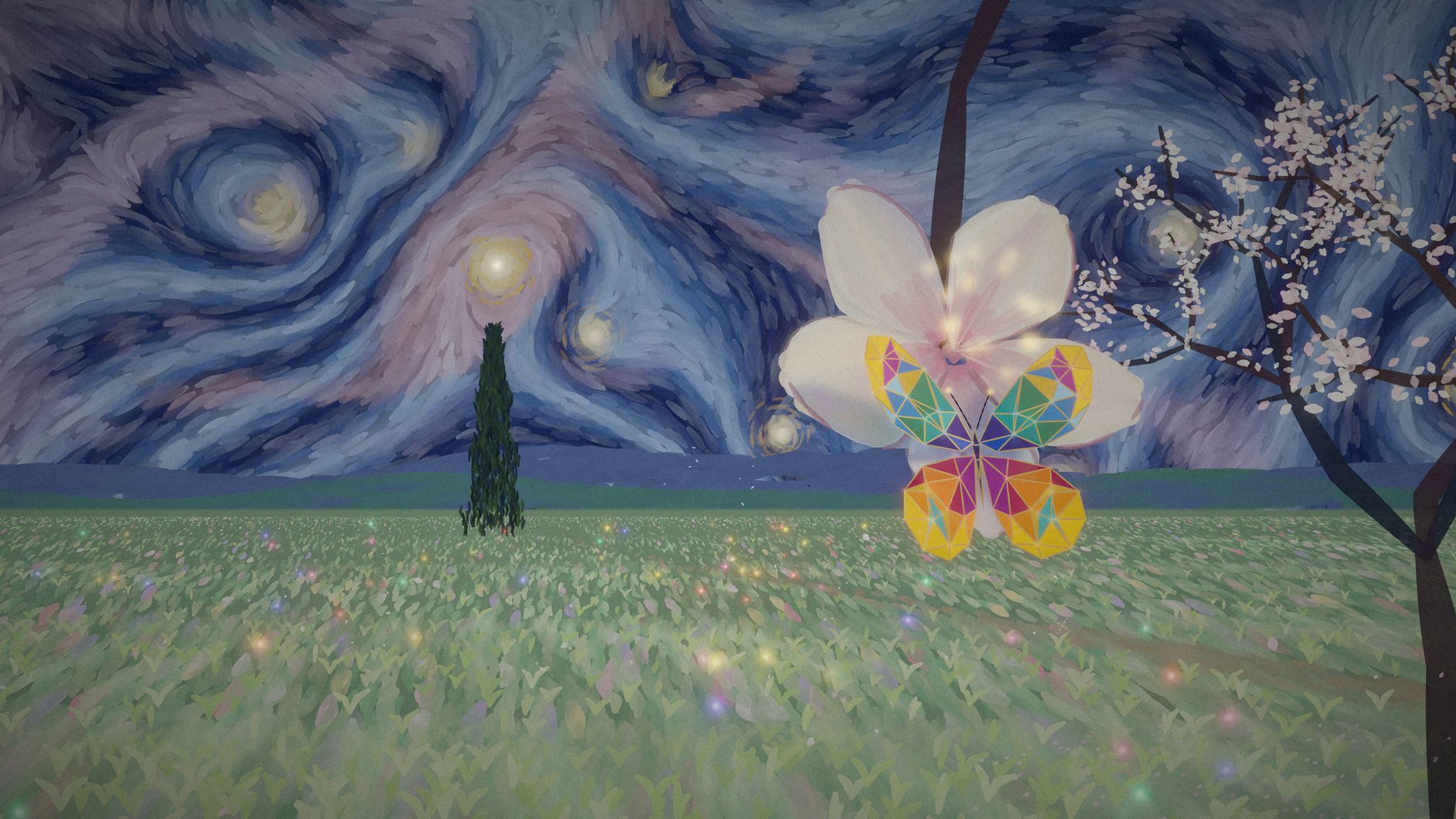
The butterfly glides down toward home. I wanted a game: as if it were flying a plane and enjoying its low passes. And then a glider, coming down already knowing where to go, gently.
The flight is a model: a mass with its lift, its drag, a thrust. Left to itself, such a flight oscillates. It trades height for speed: it dives and speeds up, climbs and slows down. This is the phugoid, described by Lanchester more than a century ago. Its period, at that speed, is the pace of the bass notes.
The trajectory is not drawn: the controls are found that bring the peaks and the troughs of the flight onto the notes. It skims the grass at thirty-five centimetres, climbs to two metres sixty on the resolution in A minor, and touches the petal at four centimetres per second. The petal yields, and comes back.
Whatever oscillates finds its rest.
Then only the wind moves.
Riccardo Donati
Enter the worldAlma Hale is a virtual artist created and directed by Riccardo Donati. Human-authored. AI-rendered.